
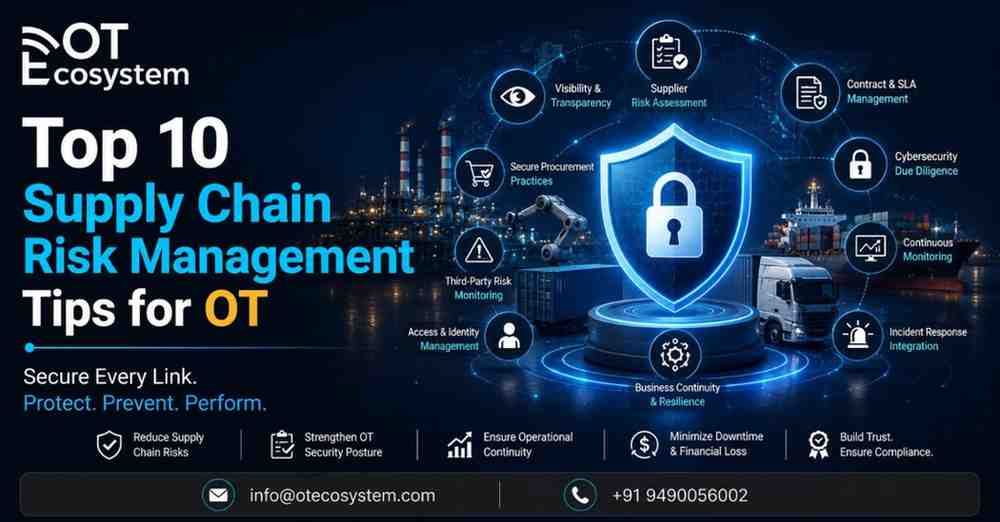
The Background: Why the OT Supply Chain is Under Siege
To understand how to protect your operations, we must first understand how the battlefield has evolved. Historically, OT environments-power grids, water treatment facilities, manufacturing plants, and oil refineries-relied on physical isolation and proprietary protocols for security. Security by obscurity was the norm.
However, the rapid convergence of IT and OT has shattered that isolation. Modern industrial operations require real-time data analytics, remote diagnostics, and cloud-based predictive maintenance. To facilitate this, Original Equipment Manufacturers (OEMs) and third-party contractors require persistent or on-demand remote access to your most critical assets: Programmable Logic Controllers (PLCs), Human-Machine Interfaces (HMIs), and Supervisory Control and Data Acquisition (SCADA) systems.
Threat actors-ranging from financially motivated ransomware gangs to sophisticated nation-state APTs (Advanced Persistent Threats)-have realized that directly attacking a hardened critical infrastructure facility is difficult. It is far easier to compromise a smaller, less secure third-party vendor, integrator, or software provider, and use their trusted access to leapfrog into the target OT network.
We have witnessed this paradigm shift vividly in recent years. Supply chain attacks involve malicious code injected into trusted software updates, compromised vendor credentials used for remote access, and even hardware vulnerabilities embedded during the manufacturing process. Because OT systems govern physical processes where human safety and environmental stability are at stake, the impact of a supply chain compromise is exponentially higher than a traditional IT data breach.
Managing this risk requires a paradigm shift from reactive defense to proactive, intelligence-driven supply chain governance. Here are the top 10 strategies to secure your industrial ecosystem.
Best 10 Supply Chain Risk Management Tips for OT
1. Mandate Software Bills of Materials (SBOMs) from All OEMs
You cannot protect what you do not know you have, and you certainly cannot patch software if you do not know what code is inside it. Modern industrial software is rarely built from scratch; it is assembled using countless third-party and open-source libraries. When a vulnerability like Log4j emerges, OT asset owners often spend weeks just trying to figure out if their SCADA software is affected.
To combat this, make it a contractual requirement for all vendors and OEMs to provide a comprehensive Software Bill of Materials (SBOM) for every application, firmware, and embedded system they supply. An SBOM acts as an ingredient list for your software, allowing your security team to instantly cross-reference newly discovered vulnerabilities against your installed base. Furthermore, integrate these SBOMs into your vulnerability management workflows to automate risk scoring based on the criticality of the underlying physical process.
2. Implement Stringent, Zero-Trust Remote Access Controls
The days of providing vendors with an “always-on” VPN connection to the plant floor must end. Compromised third-party remote access is one of the most common initial access vectors for industrial ransomware.
Instead, transition to a Zero Trust Network Access (ZTNA) model specifically designed for OT. Vendor access should be strictly governed by the principles of least privilege. Implement Privileged Access Management (PAM) solutions that require multi-factor authentication (MFA) and provide access only to the specific machine or application the vendor needs to service, rather than the entire subnet. Furthermore, enforce time-bound access-connections should automatically terminate once the maintenance window closes. Crucially, ensure that all vendor sessions are recorded and auditable, allowing your team to review exactly what commands were executed on a PLC during a remote session.
3. Conduct Deep-Dive, Continuous Vendor Risk Assessments
Traditional vendor risk management often relies on static, annual questionnaires that are essentially compliance checklists. These are insufficient for the dynamic nature of cyber threats. An OEM might be secure in January, but severely compromised by July.
Shift toward continuous, intelligence-driven vendor risk assessments. Evaluate your suppliers against recognized industrial frameworks such as IEC 62443-4-1 (Secure Product Development Lifecycle Requirements). Demand proof of their internal security practices: Do they conduct regular penetration testing on their products? What is their mean time to remediate (MTTR) a discovered vulnerability? How do they secure their own source code repositories? By tiering your vendors based on the criticality of the systems they support, you can allocate your auditing resources effectively, focusing deep-dive technical assessments on the suppliers whose compromise would cause the most operational impact.
4. Enforce Rigorous IT/OT Network Segmentation and Micro-Segmentation
A compromised supply chain partner will usually enter through the enterprise IT network or a dedicated vendor portal. If your network architecture is flat, that attacker can easily pivot laterally into the OT environment and begin manipulating industrial control systems.
Strict network segmentation, adhering to the Purdue Enterprise Reference Architecture (PERA), is mandatory. There should be a highly restrictive Industrial Demilitarized Zone (IDMZ) acting as a buffer between IT and OT. All traffic traversing the IT/OT boundary must be brokered through this IDMZ. Go a step further by implementing micro-segmentation within the OT network itself. If a vendor is servicing a specific robotic assembly line in Cell A, they should have absolutely no network routing to the chemical mixing PLCs in Cell B. Micro-segmentation limits the blast radius of a supply chain breach, preventing an isolated incident from cascading into a plant-wide outage.
5. Leverage AI-Powered OT Security Platforms Like Shieldworkz
As the threat landscape becomes more sophisticated and supply chains grow more complex, manual monitoring of third-party interactions is no longer viable. To effectively manage these risks, organizations must integrate purpose-built, intelligent defense mechanisms. A standout in this space is Shieldworkz, a next-generation cybersecurity platform designed specifically to protect OT, ICS, and IoT environments.
When a trusted vendor’s credentials are hijacked, traditional signature-based IT security tools will fail to notice the intrusion because the access appears legitimate. Shieldworkz bridges this gap by utilizing an agentic AI-powered engine that establishes a deep behavioral baseline of your industrial network. It continuously analyzes data traffic, device behavior, and control commands. If a vendor suddenly issues an anomalous Modbus write command or attempts to upload new firmware to a DCS outside of a scheduled maintenance window, Shieldworkz detects this deviation in real-time.
Furthermore, because Shieldworkz is deeply protocol-aware (understanding DNP3, OPC UA, EtherNet/IP, etc.), it provides semantic analytics without disrupting critical operations via passive deployment. For organizations struggling with the resource overhead of continuous monitoring, Shieldworkz also offers specialized OT SOC as a Service (SOCaaS). By partnering with a platform that delivers granular asset visibility and automated compliance mapping (like IEC 62443 and NIST), you effectively neutralize the blind spots inherent in modern industrial supply chains.
6. Test and Validate Patches in an Offline Sandbox
The supply chain includes the digital delivery of software updates and firmware patches. The infamous SolarWinds breach demonstrated that threat actors can compromise the build environment of a vendor, turning legitimate software updates into trojan horses.
In an OT environment, patching is already a delicate process fraught with the risk of causing system instability. You must treat every incoming patch as potentially hostile until proven otherwise. Never deploy an update directly from a vendor to your production HMIs or controllers. Establish a staging environment or offline sandbox that mirrors your production architecture. Test the patch extensively not only for operational stability but also for anomalous network behavior. Verify cryptographic hashes to ensure the file integrity matches the vendor’s secure release notes before ever allowing it near your critical control loops.
7. Secure the Physical Supply Chain and Hardware Integrity
Cybersecurity discussions often fixate on software, but the physical hardware supply chain is equally vulnerable. The grey market for industrial components is vast, and the risk of counterfeit parts or maliciously altered firmware is real. A counterfeit PLC might function normally but contain a hardware backdoor that allows unauthorized access, bypassing all network-level security controls.
Establish strict procurement guidelines that mandate purchasing only from authorized, verifiable distributors. When new hardware arrives at your facility, conduct physical inspections. Look for tamper-evident seals and verify the MAC addresses and firmware versions against the manufacturer’s secure database. Integrating hardware integrity checks into your site acceptance testing (SAT) ensures that you are not installing compromised equipment directly onto your factory floor.
8. Establish an OT-Specific Joint Incident Response Plan
When a supply chain breach occurs, time is your most critical asset. You cannot wait until an incident is actively unfolding to figure out who to call at your vendor’s organization or to determine who has the authority to sever a remote connection.
Develop an OT-specific Incident Response (IR) plan that explicitly includes your Tier 1 suppliers and integrators. Define clear Service Level Agreements (SLAs) for breach notification-if a vendor suffers a data breach, they must be contractually obligated to notify you within a strict timeframe. Conduct joint tabletop exercises with your critical vendors to simulate supply chain attacks. These drills help identify communication breakdowns and clarify roles and responsibilities, ensuring that when a crisis hits, both your team and your vendor are operating from the same playbook to contain the threat and minimize operational downtime.
9. Deploy Continuous OT Network Detection and Response (NDR)
Because you cannot control the security posture of every vendor on your network, you must have absolute visibility into what is happening within your own walls. Relying solely on endpoint protection is difficult in OT, as legacy PLCs and proprietary HMIs cannot run modern antivirus agents.
Deploy robust OT Network Detection and Response (NDR) solutions utilizing passive monitoring via SPAN ports or network TAPs. This allows you to map every asset communicating on the network and visualize the exact flow of data. If a third-party IIoT sensor suddenly begins beaconing to an unknown external IP address, or if a vendor’s engineering workstation attempts an unauthorized lateral movement via SMB, your NDR solution should flag this immediately. Continuous monitoring acts as your ultimate safety net, catching the malicious activities that slip past your perimeter controls.
10. Align Ecosystem Contracts with Global Regulatory Standards
Supply chain risk management is ultimately a governance challenge. You must use the power of the purse to force better security hygiene onto your suppliers. As global regulatory frameworks tighten, you must flow these requirements down the chain.
Ensure that your procurement contracts stipulate adherence to recognized standards such as the NIST Cybersecurity Framework, NERC CIP (for the power sector), or the European Union’s NIS2 Directive. Require your vendors to demonstrate compliance with these standards through independent third-party audits. By making robust cybersecurity a non-negotiable requirement for doing business with your organization, you not only protect your own critical infrastructure but also elevate the security posture of the entire industrial ecosystem.
Conclusion
Securing the OT supply chain is one of the most complex challenges facing industrial asset owners today. It requires a delicate balance between enabling operational efficiency and enforcing strict, zero-trust security controls. By moving away from reactive checklists and embracing proactive strategies-such as mandating SBOMs, enforcing micro-segmentation, and leveraging advanced, AI-driven platforms like Shieldworkz-you can illuminate your blind spots and regain control over your operational environment.