
Welcome back to the cybersecurity desk. As an editor mapping the high-stakes convergence of IT, OT, and MIoT, I frequently encounter organizations attempting to secure their factory floors with policies originally written for corporate laptops. This is a fundamental, and potentially disastrous, mistake. In IT, the primary goal is data confidentiality; in OT, a breach immediately compromises physical safety, environmental integrity, and continuous production.
As ransomware groups actively pivot from corporate networks to target the unpatched, legacy systems running our critical infrastructure, regulatory frameworks like ISA/IEC 62443 are moving from “best practice” to a legal mandate. In fact, recent data shows a continuous rise in sophisticated AI-driven threats aimed at industrial sites, making governance critical. Securing operational technology doesn’t start with buying the most expensive firewall; it begins with an ironclad governance structure.
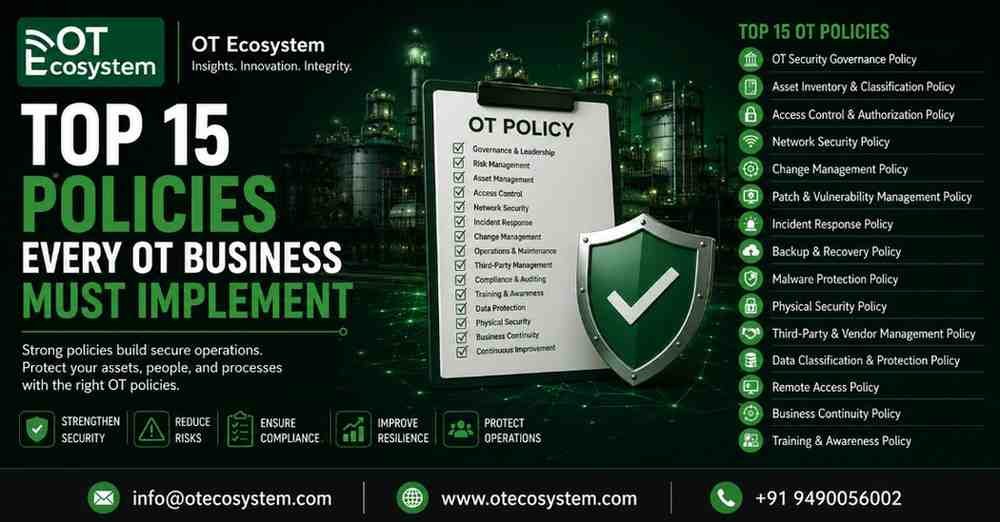
To protect your industrial assets in 2026, here are the top 15 non-negotiable cybersecurity policies every OT business must implement today, explicitly designed to secure your production line from the board room to the factory floor.
Top 15 Policies Every OT Business Must Implement
1. Cross-Functional IT/OT Governance Policy
The most critical vulnerability in industrial cybersecurity is the cultural divide between corporate IT and facility engineering. You must establish a formal steering committee where IT brings threat intelligence and OT dictates process safety context. This policy mandates joint sign-off on all security deployments, ensuring IT controls do not inadvertently cause plant downtime. Governance must be unified; if security policies are dictated from the corporate office without input from the plant floor, they will either be ignored or cause operational disaster.
2. IEC 62443 Alignment & Target Security Level (SL-T) Policy
You cannot apply a blanket security policy across a complex power plant or manufacturing facility. This policy requires engineering and security teams to collaboratively define a Target Security Level (SL-1 to SL-4) for every distinct network zone based on the actual physical consequences of a breach. For instance, a safety instrumented system protecting a hazardous chemical process requires a much higher security level (SL-3 or SL-4) than a standard building management system (SL-1).
3. Purdue Model Micro-Segmentation Mandate
The era of the flat manufacturing network is officially over. This policy explicitly forbids direct communication between the enterprise IT network and the Level 1 plant floor controllers. It mandates strict micro-segmentation using industrial Demilitarized Zones (DMZs) and deep packet inspection (DPI) to enforce logical boundaries. By implementing “deny-all” rules between these segments, you guarantee that if a corporate email is compromised, ransomware cannot easily jump to the critical PLCs.
4. Comprehensive OT Asset Inventory Policy
You simply cannot protect what you cannot see, making 100% visibility the foundational step of any OT security program. This policy dictates that the organization must maintain a dynamic, highly accurate inventory of all PLCs, HMIs, IIoT sensors, and cellular gateways. It explicitly bans the use of manual spreadsheets in favor of passive, continuous OT network scanning tools that discover assets without disrupting fragile legacy protocols. Tracking aging equipment and end-of-life status is a vital metric within this policy.
5. Compensating Controls and Risk Acceptance Policy
Legacy industrial systems often cannot be patched without voiding warranties or risking severe, 24/7 operational disruption. This policy establishes a formal, documented Compensating Controls Register. When a high-severity vulnerability cannot be patched, this document outlines the exact alternative security controls-such as strict network isolation, application allowlisting, or virtual patching at the firewall-that are actively mitigating the risk. This provides a clear audit trail for regulators.
6. Strict Third-Party Remote Access Policy
Compromised vendor VPNs remain a primary vector for cyber-physical attacks and industrial espionage. This policy outlaws persistent, unmonitored external access into your critical environment. It mandates that all third-party maintenance connections route through a dedicated OT jump server, utilize phishing-resistant Multi-Factor Authentication (MFA), and are strictly time-bound and logged. Vendors should only receive access under the principle of least privilege, directly minimizing your attack surface.
7. OT-Specific Incident Response (IR) Playbook Policy
An IT incident response plan will likely instruct a team to isolate and wipe an infected machine-a move that could catastrophically blind plant operators to a critical physical process. This policy requires the creation of IR playbooks tailored specifically for OT, accounting for safety validations and manual overrides. It mandates regular tabletop exercises involving both IT security personnel and plant floor engineers to practice safely failing over to manual operations during a simulated ransomware outbreak.
8. Immutable SCADA and PLC Logic Backup Policy
If a sophisticated wiper malware destroys your control configurations, production stops indefinitely and recovery could take weeks. This policy mandates the 3-2-1 backup rule for all operational logic, prioritizing the rapid restoration of physical processes. It requires that verified, immutable copies of PLC logic and HMI configurations are stored completely offline, safe from network encryption. Crucially, the policy must outline regular bare-metal restoration tests to validate recovery time objectives (RTOs).
9. Safety Instrumented Systems (SIS) Air-Gap Policy
Safety systems are the absolute last line of defense preventing catastrophic physical disasters, explosions, or environmental releases. Adversaries specifically target these systems to blind operators before initiating a destructive attack. This policy demands that SIS controllers are logically and physically isolated from the basic process control system (BPCS). They must never share underlying network infrastructure, engineering workstations, or administrative credentials with the standard control network.
10. Default Password Elimination and Identity Policy
Default passwords on legacy industrial controllers are widely documented on the dark web and are actively exploited by novice hackers and APTs alike. This policy strictly forbids the use of default credentials across the entire OT ecosystem. It requires the implementation of centralized identity management where technically feasible, or highly managed, trackable local password vaults for legacy devices. The goal is to eliminate shared administrative logins that obscure individual accountability.
11. Removable Media and USB Control Policy
The Stuxnet blueprint is still highly relevant today. In air-gapped or heavily segmented OT environments, infected USB drives remain the most common vector for initial malware infection. This policy strictly regulates the use of all removable media within the facility. It requires all USBs to be scanned, cleaned, and verified at standalone kiosk stations before they are permitted to connect to any engineering workstation or device on the factory floor.
12. Supply Chain Security and SBOM Policy
As adversaries increasingly target smaller vendors to introduce vulnerabilities deep within firmware, asset owners must demand transparency. This policy holds original equipment manufacturers (OEMs) and system integrators accountable. It requires procurement teams to demand a Software Bill of Materials (SBOM) for all new automation assets. Furthermore, it enforces strict contractual obligations for timely vulnerability disclosures and secure-by-design manufacturing principles.
13. Passive Threat Monitoring and Anomaly Detection Policy
Traditional active vulnerability scanning can accidentally crash legacy HMIs and disrupt time-sensitive manufacturing processes. This policy dictates the use of continuous, passive network monitoring. It requires the deployment of tools capable of parsing proprietary industrial protocols (like Modbus, CIP, and DNP3) to detect unauthorized commands. By establishing a behavioral baseline, SOC teams can identify telemetry drift and intercept adversaries early in the reconnaissance phase.
14. Application Allowlisting for Engineering Workstations
Preventing the execution of unauthorized binaries is far more effective than trying to catch every new malware signature. This policy enforces application allowlisting on highly vulnerable endpoints, particularly Windows-based SCADA servers and engineering workstations. This ensures that only explicitly approved, cryptographically signed software can execute, neutralizing ransomware and malicious payloads even if they successfully bypass the perimeter firewall.
15. Continuous OT Cybersecurity Awareness Training Policy
Human error and social engineering remain the most persistent vulnerabilities across both IT and OT domains. This policy mandates annual, role-specific cybersecurity training tailored specifically for plant operators, process engineers, and maintenance staff. The curriculum must focus heavily on recognizing phishing tactics, deepfake voice clones, and social engineering attempts designed to harvest remote access credentials or bypass physical facility security controls.
Track Your Policy Compliance
Implementing these 15 policies isn’t a one-time project; it requires continuous evaluation. Use the interactive checklist below to map your facility’s current compliance against these critical OT security requirements:
Conclusion
Drafting security policies without operational context is merely an exercise in compliance theater. To truly secure your industrial control systems in 2026, these 15 policies must be woven directly into the daily workflows of your engineers, operators, and IT staff. By aligning your governance structure with globally recognized frameworks like IEC 62443 and prioritizing physical safety above all else, you transform your operational technology from a vulnerable target into a highly resilient ecosystem. Build the foundation now, before the next zero-day exploit finds its way onto your factory floor.