
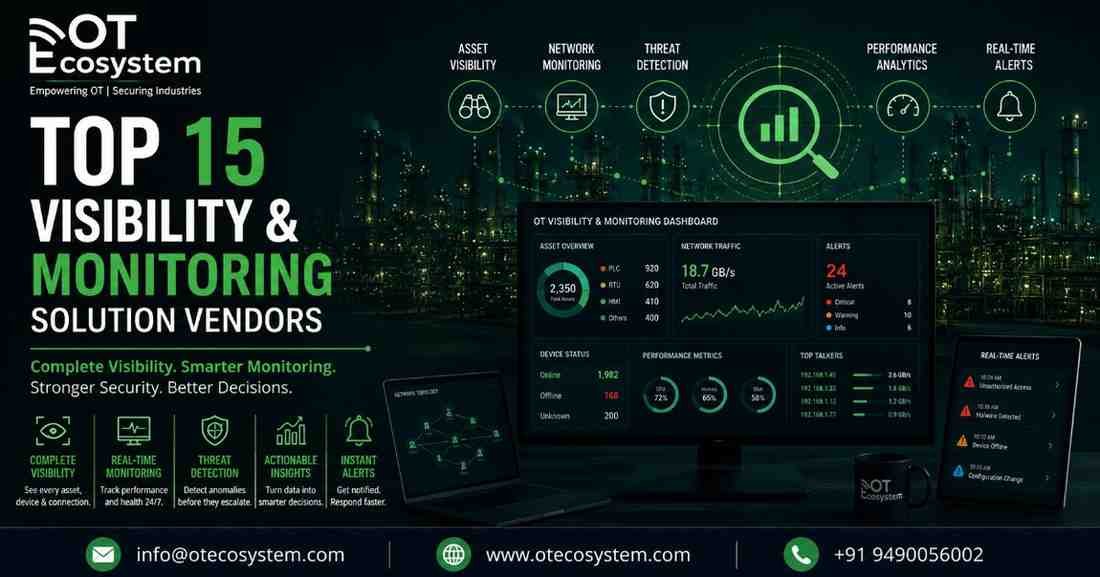
Explore the top 15 OT/ICS visibility and monitoring solution vendors for 2026. Secure your critical infrastructure with leading industrial security platforms.
The Critical Need for OT Visibility in 2026
In today’s hyper-connected industrial landscape, the convergence of Information Technology (IT) and Operational Technology (OT) is no longer a future trend-it is a present-day reality. While this integration drives efficiency and predictive maintenance through the Industrial Internet of Things (IIoT), it simultaneously exposes sensitive industrial control systems (ICS) to the vast, volatile threat landscape of the internet. Traditional IT security tools, designed primarily for data confidentiality, often fail in OT environments where the absolute priority is the safety, reliability, and continuous availability of physical processes.
Visibility is the foundational pillar of any resilient OT security strategy. You cannot protect what you cannot see, and in an environment where a single misconfigured firewall or an unauthorized firmware change can lead to catastrophic physical downtime, deep asset awareness is non-negotiable. Modern visibility and monitoring solutions are specifically engineered to provide non-intrusive, passive discovery of assets like PLCs, RTUs, and HMIs, while decoding proprietary industrial protocols. As we navigate 2026, the market has shifted toward platforms that provide not just “lists” of devices, but actionable intelligence that correlates network anomalies with potential operational risks, allowing security teams to act before a threat escalates into a safety incident.
Understanding the OT Monitoring Landscape
The market for visibility and monitoring has evolved into a sophisticated ecosystem. Leading vendors today provide “purpose-built” security, meaning their platforms are designed with an acute understanding of industrial physics and protocol behaviors. Key capabilities now include:
- Passive Asset Discovery: Identifying every connected device without active scanning, which could otherwise crash fragile, legacy industrial hardware.
- Deep Packet Inspection (DPI): Analyzing traffic within industrial protocols (such as Modbus, DNP3, or PROFINET) to spot malicious commands or anomalous behavior.
- Behavioral Baselining: Using advanced analytics to learn the “normal” communication pattern of a network and alerting only when deviations occur.
- Contextual Risk Assessment: Prioritizing vulnerabilities based on their potential impact on physical safety rather than just a generic severity score.
Top 15 Visibility & Monitoring Solution Vendors
1. Dragos
Dragos remains a cornerstone of the OT security market, primarily due to its world-class industrial threat intelligence. Their platform excels in environments where understanding the “who, what, and why” behind an attack is paramount. By providing ICS-specific playbooks and incident response capabilities, Dragos ensures that security teams can mitigate threats without jeopardizing operational uptime. Their deep visibility into adversary tactics makes them a preferred choice for critical infrastructure operators who need to defend against sophisticated, targeted industrial cyber-attacks.
2. Claroty
Claroty is widely recognized for its platform breadth, offering unmatched visibility into the Extended Internet of Things (XIoT). Their “xDome” platform is specifically designed for complex, multi-site environments where IT, OT, and IoMT (Internet of Medical Things) converge. With a heavy focus on deep asset discovery and vulnerability management, Claroty provides the granular detail needed to map out an entire industrial network. Their ability to handle high-scale, heterogeneous environments makes them an essential partner for global enterprises looking to unify their security posture.
3. Shieldworkz
Shieldworkz has established itself as a pioneering force by integrating agentic AI directly into the heart of their OT security suite. Their platform excels in delivering the industry’s most in-depth asset inventory, often reporting significantly more assets than traditional competitors through advanced behavioral analysis. By automating posture management and threat intelligence ingestion, Shieldworkz simplifies the daily workflow for security analysts, effectively acting as an “on-the-go” expert. Their non-intrusive network detection and protocol-aware inspection make them an ideal choice for organizations needing rapid, high-fidelity visibility that bridges the gap between IT security and shop-floor engineering requirements.
4. Nozomi Networks
Nozomi Networks is a leader in scalable OT and IoT monitoring, particularly for distributed industrial environments. Their “Vantage” SaaS offering allows organizations to manage visibility across disparate global sites from a centralized, AI-powered dashboard. Nozomi’s strength lies in its ability to process massive amounts of network telemetry to detect anomalies in real-time, all while maintaining a user-friendly interface. They are a go-to solution for energy providers and smart city operators who need a platform that scales effortlessly as their connected asset footprint grows.
5. Armis
Armis provides a powerful, agentless approach to asset intelligence that is highly effective for heterogeneous environments. Because their platform is cloud-native and operates without requiring agents on sensitive controllers, it is uniquely suited for environments that cannot risk third-party software interference. Armis excels at identifying and profiling every device-from standard IT servers to niche industrial sensors-and mapping their relationships in real-time. This holistic visibility allows teams to catch lateral movement early, preventing attackers from pivoting from the enterprise network into the production zone.
6. Tenable
Tenable has successfully bridged the IT/OT gap by extending its robust vulnerability management capabilities into the industrial space. For organizations already utilizing Tenable for IT security, their OT modules provide a familiar, intuitive interface that streamlines the vulnerability lifecycle across the entire enterprise. Their solution is particularly strong at identifying firmware-level vulnerabilities and prioritizing them based on business risk, helping security teams focus their limited resources on the most critical industrial assets.
7. Fortinet
Fortinet delivers a network-centric security experience, embedding OT-specific visibility directly into their FortiGate firewalls and FortiGuard services. Their solution is ideal for industrial organizations that prioritize network segmentation as a primary defense against lateral movement. By providing consistent security policies and centralized visibility across both IT and OT networks, Fortinet helps organizations streamline their security operations and reduce the time required to detect and contain threats at the network perimeter.
8. Palo Alto Networks
Palo Alto Networks remains the gold standard for enterprises already invested in the broader Palo Alto security ecosystem. Their “Prisma” and “Cortex” product lines offer enterprise-grade visibility that extends seamlessly into the industrial network. By leveraging their massive threat intelligence database, they provide highly accurate detection of both IT-borne threats and those specifically targeting industrial protocols. This makes them a top choice for large organizations seeking a unified security architecture that covers everything from the data center to the factory floor.
9. TXOne Networks
TXOne Networks has gained massive traction by specializing in “Zero-Disruption” protection for modern industrial environments. Their portfolio is specifically designed to secure legacy assets that cannot be easily updated, patched, or scanned. With solutions like their EdgeIPS and Virtual Portable Inspector, TXOne allows operators to maintain high security without the risk of system instability. Their focus on device-level security makes them a critical partner for organizations with mission-critical machinery that must remain online at all times.
10. Elisity
Elisity is redefining how organizations handle network segmentation through an innovative, identity-based approach. Instead of relying on rigid, hardware-heavy firewall architectures, they utilize a software-only, cloud-managed platform that sits on existing switches to enforce granular control. This makes them a perfect fit for organizations struggling to secure legacy infrastructure without the need for a massive “rip and replace” overhaul. Their platform provides a centralized control center that simplifies the management of complex, multi-site industrial networks.
11. CrowdStrike
CrowdStrike has successfully leveraged its cloud-native Falcon platform to provide unified IT and XIoT (Extended IoT) visibility. Their strength lies in a massive, global threat intelligence network, which provides early warning of incoming attacks that might target specific industrial sectors. For organizations seeking to consolidate their entire security stack into a single, high-performance agent-based platform, CrowdStrike is an industry leader, offering rapid incident response capabilities that are highly effective for distributed industrial sites.
12. Darktrace
Darktrace is the pioneer of “self-learning” AI in industrial cybersecurity. Their technology builds a dynamic “pattern of life” for every single device on the network, enabling them to detect anomalies in real-time without the need for manual rules or signature updates. For industrial environments that are highly dynamic, or where the threat landscape is evolving faster than teams can write rules, Darktrace offers an autonomous, adaptive response that protects against both known and novel threats.
13. Cisco
Cisco leverages its deep networking expertise to provide secure, resilient connectivity for the industrial internet of things (IIoT). Their managed industrial security services combine a robust hardware portfolio with sophisticated detection and response capabilities designed to protect the critical communication paths within industrial environments. With a strong focus on visibility and network-wide segmentation, they enable organizations to enforce strict access controls, preventing lateral movement in interconnected OT networks.
14. Otorio
Otorio specializes in industrial digital security and risk management, providing a platform that emphasizes continuous monitoring and operational resilience. They are particularly strong in helping organizations translate technical security findings into “business risk” language, which is vital for communicating with executive leadership. By focusing on both security and operational productivity, Otorio helps plants maintain compliance and safety while actively hardening their network against potential cyber-physical disruptions.
15. Forcepoint
Forcepoint provides a robust set of security tools that focus on the “human element” of cybersecurity, including data protection and secure access for distributed environments. Their industrial offerings are designed to provide visibility into the movement of sensitive industrial data, which is crucial for protecting intellectual property. By combining deep packet inspection with sophisticated user behavior analytics, Forcepoint helps industrial organizations ensure that only authorized personnel and processes have access to their most critical control systems.
Conclusion
Selecting the right visibility and monitoring solution is not about choosing the biggest name in the industry; it is about finding the partner that aligns with your operational constraints and security maturity. As we look at the leaders in the market-from dedicated OT specialists like Shieldworkz and Dragos to broader enterprise security platforms like Palo Alto and CrowdStrike-the key is to prioritize solutions that offer passive, non-intrusive monitoring and deep, protocol-aware visibility. By investing in these foundational technologies, industrial organizations can gain the insight necessary to secure their infrastructure against the threats of 2026 and beyond.