
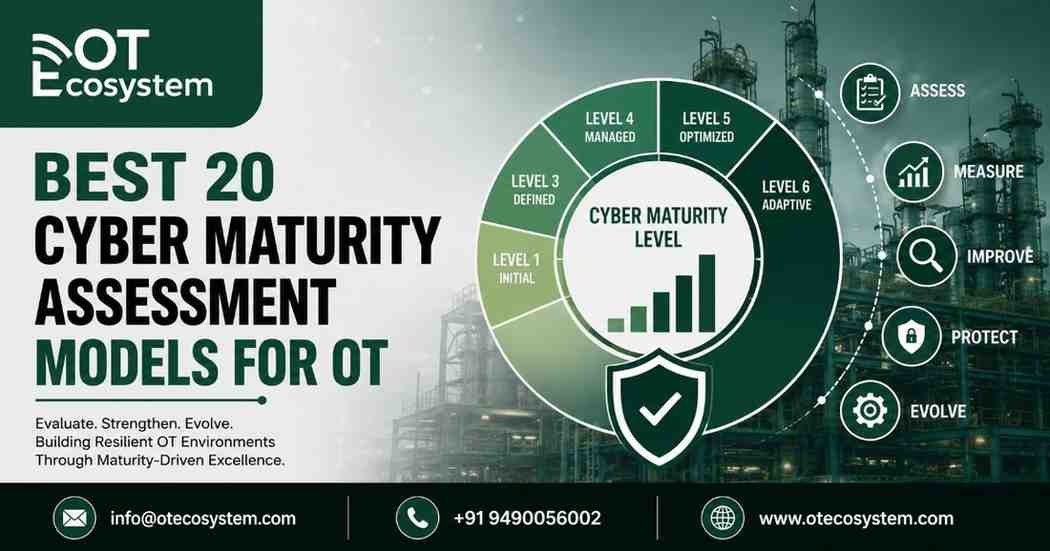
If you cannot measure it, you cannot secure it. As the industrial attack surface expands through the integration of cloud analytics, edge computing, and smart sensors, organizations are struggling to answer a basic question: How secure is our operational technology?
To answer that, you need an OT-specific maturity model. These frameworks move organizations from a reactive, chaotic state to a proactive, optimized, and quantifiable security posture. Here are the 20 most critical models and frameworks you should be evaluating today.
Best 20 Cyber Maturity Assessment Models for OT
1. The Cybersecurity Capability Maturity Model (C2M2)
Originally developed by the Department of Energy (DOE) for the energy sector, C2M2 is arguably the most recognized maturity model for critical infrastructure. It evaluates capabilities across 10 domains (like Identity Management and Threat and Vulnerability Management) and assigns a Maturity Indicator Level (MIL) from 0 to 3. It is exceptional for organizations needing a rigorous, standardized way to measure their OT posture.
2. IEC 62443 Security Levels (SL)
While IEC 62443 is a sprawling series of standards rather than a single assessment tool, its concept of “Security Levels” (SL 1 through SL 4) serves as the foundational maturity model for industrial automation. An assessment against IEC 62443 evaluates whether your architecture, zones, and conduits can withstand adversaries ranging from casual hackers (SL 1) to nation-state actors (SL 4).
3. The NIST Cybersecurity Framework (CSF) 2.0 (OT Profile)
The NIST CSF is the lingua franca of cybersecurity. While its core functions (Identify, Protect, Detect, Respond, Recover, and now Govern in version 2.0) apply broadly, specific OT profiles have been developed. These profiles map the CSF directly to industrial environments, allowing CISOs to speak a common language across both IT and OT domains.
4. ARC Advisory Group’s Industrial Cybersecurity Maturity Model
Designed by industrial analysts, this model maps the progression from “Secure Architecture” (Level 1) up to “Proactive” (Level 5). It is highly pragmatic, focusing on the deployment of specific technologies-from basic firewalls and asset inventory to advanced anomaly detection and predictive analytics.
5. SANS ICS/OT Security Maturity Model
SANS is the premier training organization for cybersecurity. Their maturity model for ICS emphasizes the human element and active defense. It progresses from “Awareness” through “Architecture/Active Defense,” culminating in “Intelligence-Driven Defense,” prioritizing the training of personnel to actively hunt threats on the plant floor.
6. Threat-Informed OT Maturity Assessments
These are bespoke assessments (often offered by specialized firms like Dragos or Mandiant) that map your OT defenses directly against known adversary Tactics, Techniques, and Procedures (TTPs), specifically using the MITRE ATT&CK for ICS framework. It measures how effectively your organization can detect and disrupt specific, real-world industrial threat actors.
7. ISA/IEC 62443-2-1 Maturity Assessment
A specific subsection of the 62443 standard, this focuses entirely on the maturity of the organization’s cybersecurity management system (CSMS). It measures the maturity of policies, procedures, and governance structures required to maintain an OT security program, scaling from initial (ad-hoc) to continuous improvement.
8. The Purdue Enterprise Reference Architecture (PERA) Model Assessment
While PERA is an architectural model rather than a strict maturity scoring tool, network segmentation assessments base their maturity scores almost entirely on adherence to Purdue. A low maturity score indicates a flat network; a high score indicates strict enforcement of an Industrial Demilitarized Zone (iDMZ) and micro-segmentation.
9. NERC CIP Compliance & Maturity Assessments
For the North American bulk electric system, NERC CIP is mandatory. However, specialized assessment models evaluate an organization’s maturity beyond baseline compliance. They measure how efficiently and securely an organization exceeds the minimum requirements for asset visibility, incident reporting, and supply chain risk management.
10. NIS2 Readiness and Maturity Frameworks
With the enforcement of the EU’s NIS2 Directive, numerous consultancies have developed maturity assessments to evaluate readiness. These models specifically score an organization’s capabilities regarding incident reporting (the 24-hour rule), supply chain security, and corporate governance accountability.
11. OPA (Open Process Automation) Security Architecture Assessments
As industries move toward open, interoperable control systems (like those championed by the Open Group), maturity models are emerging to evaluate the security of these decoupled architectures. These assess the maturity of zero-trust implementations across diverse, multi-vendor edge compute nodes.
12. OT-Specific Zero Trust Maturity Models
Applying Zero Trust to OT is uniquely challenging. Specialized maturity assessments evaluate an organization’s progression from implicit trust (relying solely on air gaps) to explicit, continuous verification of identity, device health, and network authorization at the lowest levels of the Purdue model.
13. VDI/VDE 2182 (IT Security for Industrial Automation)
A prominent standard in Germany and parts of Europe, this framework provides a structured methodology for risk assessment and security implementation in industrial automation. Assessments based on this guideline help organizations map physical processes to cybersecurity controls.
14. The FAIR (Factor Analysis of Information Risk) Model for OT
While traditionally used in IT, FAIR is increasingly being adapted for OT to quantify cyber risk in financial terms. A FAIR-based maturity assessment evaluates an organization’s ability to calculate the probable frequency and probable physical/financial magnitude of an ICS cyber incident.
15. CISA’s Cyber Security Evaluation Tool (CSET)
Provided by the US Cybersecurity and Infrastructure Security Agency, CSET is a desktop software tool that guides organizations through a step-by-step evaluation of their IT and OT network security practices, heavily utilizing standards like NIST and C2M2 to generate a maturity baseline.
16. The Industrial Internet Consortium (IIC) Security Framework
For organizations heavily deploying Industrial IoT (IIoT), the IIC framework provides a maturity assessment model focused on the complex interactions between edge sensors, fog computing, and cloud analytics, evaluating the maturity of data protection and endpoint identity.
17. API RP 1164 Assessment (Pipeline Security)
Developed by the American Petroleum Institute, this standard provides a framework for managing cybersecurity in pipeline control systems. Maturity assessments based on 1164 are highly specialized for the oil and gas sector, focusing heavily on wide-area SCADA networks.
18. UK NCSC Cyber Assessment Framework (CAF)
Developed by the UK’s National Cyber Security Centre, the CAF provides a systematic and comprehensive approach to assessing the extent to which cyber risks to essential functions are being managed. It is widely used by critical national infrastructure operators to demonstrate regulatory compliance.
19. Australian NCSC HSE (Health, Safety, and Environment) Cyber Integration Models
These specialized maturity assessments focus on the intersection of cybersecurity and physical safety. They evaluate how well an organization’s cyber incident response plans are integrated with their physical emergency shutdown and evacuation protocols.
20. Customized OEM/Vendor Assessments (e.g., Siemens, Rockwell, ABB)
Major industrial vendors offer their own maturity assessments. While tied to their ecosystems, they are highly effective at evaluating the specific, deep-level configuration maturity of their proprietary PLCs, DCS, and safety systems.
Conclusion
Securing an operational technology environment is a journey, not a destination. Selecting the right maturity model is the critical first step in that journey. Whether you are aiming for basic compliance under NERC CIP, preparing for the strict governance of NIS2, or pursuing intelligence-driven defense utilizing MITRE ATT&CK for ICS, these 20 models provide the necessary roadmap. By establishing a quantifiable baseline today, industrial organizations can prioritize their investments, close the gap between IT and OT, and ensure the resilient, safe operation of their most critical physical assets.