
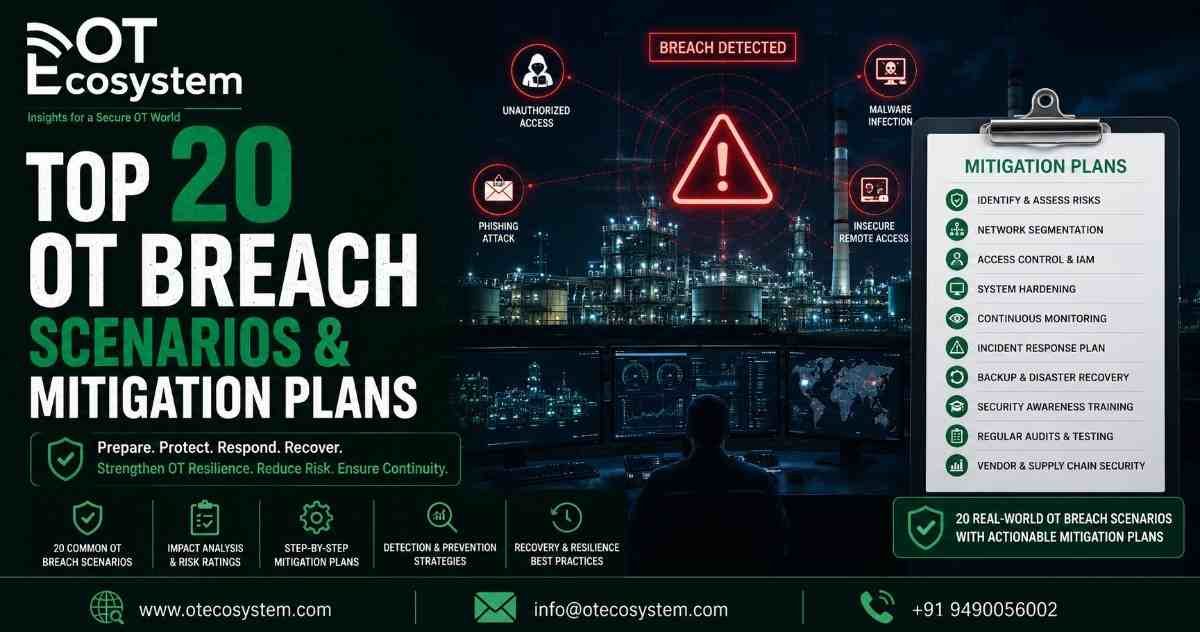
As industrial organizations accelerate digital transformation, the operational technology (OT) threat landscape has entered a volatile era. Recent 2026 threat intelligence data reveals that manufacturing and critical infrastructure account for over 30% of all global cyber incidents, with threat actors increasingly prioritizing operational downtime and data extortion over simple network intrusion. Because industrial control systems (ICS), SCADA architectures, and distributed control systems (DCS) were originally engineered for continuous uptime rather than cryptographic resilience, security leaders must look beyond generic corporate defenses. Below is a comprehensive editorial breakdown of the top 20 operational technology breach scenarios, presented with expert mitigation strategies designed for modern plant floors.
Top 20 OT Breach Scenarios & Mitigation Plans
1. Enterprise-to-OT Pivot via Compromised VPN Gateways
When attackers compromise corporate IT networks through credential stuffing or phishing, they frequently locate unmonitored virtual private network (VPN) tunnels bridging enterprise environments directly to shop-floor automation layers. To counter this lateral movement, security managers must enforce strict zero-trust network access (ZTNA) principles, implement hardware-token or certificate-based multi-factor authentication (MFA) for all remote access points, and deploy automated session termination scripts for idle vendor tunnels.
2. Unauthorized Third-Party Vendor Laptop Ingestion
Contracted maintenance engineers often plug personal laptops directly into active supervisory control buses, such as Modbus TCP or Profibus, without undergoing proper endpoint hygiene checks. Mitigating this risk requires establishing a strict pre-connection quarantine zone where all external hardware undergoes automated malware scanning and network isolation before interacting with critical control loops.
3. Rogue IIoT Device Injection (“Shadow OT”)
Department managers frequently deploy unapproved wireless sensors, smart meters, or cellular gateways to track line efficiency, introducing unmanaged entry points that bypass IT governance. Combating shadow OT requires deploying continuous asset discovery tools. Specialized inspection platforms-including market leaders such as Nozomi Networks, Dragos, Claroty, Shieldworkz, and TXOne Networks-must be integrated to map unmanaged wireless traffic, rogue switches, and hidden endpoints in real-time.
4. Industrial Historian Data Exfiltration & Extortion
Malicious actors routinely target industrial data historian servers, which aggregate high-frequency process telemetry and recipes, threatening to leak proprietary intellectual property or manipulate logs. Defense requires database-level micro-segmentation, full encryption of historian streams in transit and at rest, and air-gapped, immutable backups of all operational trend data.
5. Malicious Firmware Flashing on Safety Instrumented Systems (SIS)
Advanced persistent threat (APT) groups frequently target engineering workstations to upload modified ladder logic or corrupted firmware directly to safety controllers, disabling critical trip limits. Plant teams must enforce cryptographic checksum verification and dual-person authorization (the four-eyes principle) before any controller flashing occurs, supported by an offline “golden image” repository.
6. Human-Machine Interface (HMI) Default Credential Abuse
Operators frequently leave shop-floor HMIs running with default vendor credentials, allowing attackers on the local subnet to issue unauthorized remote commands to industrial valves and motors. Organizations must enforce strict password rotation policies, disable default accounts, implement role-based access control (RBAC) tied to individual employee badges, and configure aggressive session auto-lockouts.
7. Purdue Model Architectural Flattening
Flat network designs allow corporate office traffic to communicate directly with Level 0-2 industrial controllers, exposing real-time control loops to enterprise ransomware. Re-architecting networks according to the Purdue Reference Model by inserting industrial-grade firewalls and unidirectional data diodes between Level 3 operations and Level 4 enterprise IT is vital to stopping this risk.
8. Engineering Workstation Dual-NIC Exploitation
Using a single engineering laptop alternately on the corporate internet for email and software updates and directly on the plant control network carries malware straight into the core control loop. Strict network interface card (NIC) segregation policies must be enforced, completely isolating engineering environments from standard corporate networks.
9. PLC Memory Manipulation via Unencrypted Serial-to-Ethernet Converters
Legacy serial communication lines adapted to modern Ethernet networks lack cryptographic protections, allowing attackers on local subnets to inject unauthorized read/write commands into PLC memory registers. Mitigation involves wrapping legacy serial protocols in secure protocol wrappers and deploying industrial protocol-aware firewalls to inspect packet payloads.
10. Supply Chain Software Bill of Materials (SBOM) Compromise
Commercial-off-the-shelf HMI and SCADA software packages occasionally ship with compromised open-source libraries or hidden backdoors from third-party vendors. Plant managers must demand verified Software Bills of Materials (SBOMs) for all software deployments and run continuous vulnerability scans within an isolated test lab environment.
11. DNS/NTP Spoofing in Distributed Control Systems (DCS)
Attackers compromising local network timing or name-resolution services can desynchronize coordinated industrial controllers across a plant floor, triggering emergency safety shutdowns. Hardened, authenticated internal Network Time Protocol (NTP) servers with cryptographic signatures and restricted local DNS modifications are essential countermeasures.
12. USB-Mediated Air-Gap Jumping (Dropper Attack)
Threat actors frequently drop infected USB drives in plant parking lots; curious employees plug them into diagnostic stations that later connect to core engineering networks. Physically blocking all USB ports on critical workstations using port locks and providing managed kiosk stations for necessary data transfers eliminates this vector.
13. Advanced Phishing Targeting Control Room Operators
Spear-phishing emails targeting operational staff simulate routine vendor ticketing alerts, tricking operators into revealing credentials or executing macro-laden documents. Organizations must conduct OT-specific cybersecurity awareness training focused on engineering social engineering tactics and fake maintenance requests.
14. Cloud-Connected SCADA Misconfiguration & API Exposure
Plant telemetry pushed to cloud dashboards or external analytics providers is frequently left exposed via unauthenticated APIs or misconfigured storage buckets. Enforcing cloud posture management (CSPM), mandating MFA for all cloud-hosted portals, and executing routine external penetration tests resolves this vulnerability.
15. Ransomware Encryption of Manufacturing Execution Systems (MES)
Ransomware targeting the MES database halts production tracking, inventory scheduling, and barcode routing, forcing commercial shutdowns even if underlying PLCs remain untouched. Mitigation relies on rigorous, air-gapped backup schedules specifically targeting MES databases, paired with quarterly live-recovery simulations.
16. Wireless Mesh Network Jamming & Spoofing
Attackers utilize inexpensive hardware to jam or spoof industrial wireless mesh sensor networks, creating false temperature or pressure readings that force automated safety interlocks to trip. Monitoring RF spectrum anomalies via dedicated wireless intrusion detection systems (WIDS) and enforcing WPA3-Enterprise security protects these links.
17. Insider Threat and Disgruntled Operator Sabotage
Disaffected employees can use unrevoked administrative credentials to alter recipe parameters, change trip thresholds, or delete backups. Automated identity credential revocation upon employee offboarding, strict least-privilege access principles, and automated behavioral anomaly detection for privileged accounts prevent these actions.
18. Physical Enclosure & RTU Tampering
Physical security lapses allow intruders to access unmonitored remote terminal unit (RTU) enclosures in the field, connect to internal diagnostic ports, and inject malicious logic. Aligning physical badge and door-prop intrusion sensors with digital security operations center (SOC) alerts ensures rapid detection.
19. Loss of View / Loss of Control (Silent Sabotage)
Attackers can intercept communications between field sensors and control rooms, feeding stale, normal process readings back to operators while physical conditions quietly deteriorate. Deploying out-of-band, independent safety instrumentation systems (SIS) and mechanical hard-wired interlocks operating separately from digital control networks mitigates this risk.
20. Inadequate Incident Response & Delayed OT Islanding
During active intrusions, IT incident responders attempting to isolate a network by shutting down core industrial switches can accidentally cut power to critical cooling loops and cause environmental disasters. Developing and rehearsing a specialized OT Incident Response playbook that defines clear “safe islanding” procedures ensures compromised controllers are decoupled into safe manual-override states without jeopardizing physical process safety.
Conclusion
As operational technology environments continue to converge with corporate enterprise networks, defending the modern plant floor requires shifting from reactive patchwork to continuous, context-aware cyber resilience. The growing velocity of ransomware campaigns, supply chain compromises, and targeted ICS intrusion tactics underscores that industrial security is fundamentally about protecting human safety, environmental integrity, and continuous physical production. By systematically implementing these 20 mitigation strategies and establishing rigorous cross-functional alignment between IT professionals and plant engineering teams, organizations can future-proof their operations against the next generation of sophisticated industrial threats.