
The Evolution of Remote Connectivity in Operational Technology: Background
For decades, Operational Technology (OT) and Industrial Control Systems (ICS) relied heavily on physical air-gaps and isolated architectures. Plant managers, automation engineers, and original equipment manufacturers (OEMs) managed facilities through localized Human-Machine Interfaces (HMIs) and hardwired serial connections. However, the rapid acceleration of Industry 4.0, cloud-based telemetry, predictive maintenance, and global supply chain integrations has dismantled the traditional physical perimeter. Today, field technicians use remote diagnostic tunnels to troubleshoot programmable logic controllers (PLCs), vendors monitor turbine health from across the globe, and corporate analysts pull real-time production metrics into cloud historians.
While remote connectivity offers significant operational efficiency, cost reductions, and rapid incident resolution, it simultaneously introduces substantial cyber-physical risk. Remote access bridges-originally designed for administrative convenience-frequently bypass traditional perimeter defenses and pierce Purdue Model segmentation. Unlike IT environments where a security breach primarily risks data confidentiality, a remote breach in an OT environment can lead to unauthorized logic modifications, production halts, physical equipment destruction, or environmental hazards. Securing remote connectivity requires shifting from basic perimeter VPNs to zero-trust, protocol-aware access controls that maintain absolute operational safety.
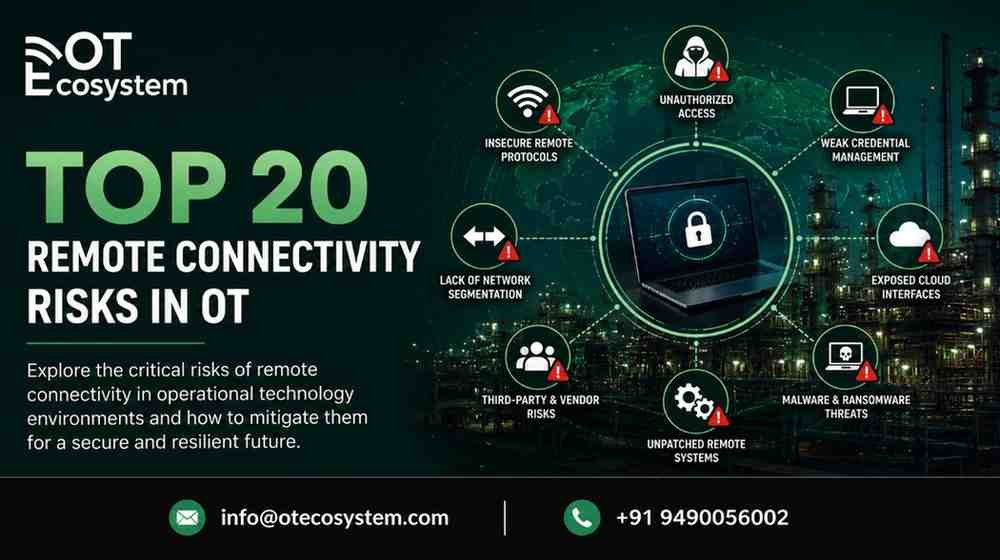
Top 20 Remote Connectivity Risks in OT
1. Unmanaged Third-Party Vendor Access Tunnels
Industrial facilities routinely rely on third-party OEMs, contractors, and managed service providers for specialized maintenance. These external entities often mandate persistent, always-on remote access tunnels into critical plant machinery without integrating into the asset owner’s central identity governance framework. Security teams frequently lack visibility into when vendors connect, what actions they perform, or how securely their external endpoints are maintained. An attacker who breaches a vendor’s corporate network can leverage these trusted pathways to pivot directly into the plant floor, completely bypassing primary firewalls.
2. Legacy Virtual Private Network (VPN) Vulnerabilities
Many industrial sites rely on aging, perimeter-based VPN appliances to grant remote engineering access to plant networks. These legacy gateways often contain unpatched software vulnerabilities, lack modern cryptographic standards, and grant broad network-level access upon connection. Once an adversary authenticates through a vulnerable enterprise VPN, they obtain direct layer-3 IP access to the internal network, enabling them to scan and compromise connected PLCs, HMIs, and safety systems.
3. Absence of Multi-Factor Authentication (MFA) on Remote Gateways
Relying solely on static, single-factor credentials for remote engineering access exposes industrial networks to severe exploitation. Threat actors routinely harvest passwords through phishing, credential stuffing, or dark web dumps, using them to log into remote administrative portals. Without mandatory multi-factor authentication (MFA)-specifically hardware security keys or time-based one-time passcodes (TOTP)-stolen credentials grant adversaries direct access to plant control systems without triggering security alarms.
4. Insecure Direct Exposure of Remote Desktop Protocol (RDP)
Exposing native Remote Desktop Protocol (RDP) ports (TCP 3389) directly to the public internet creates a severe vulnerability for automated attacks. Plant operators sometimes expose RDP sessions on engineering workstations to simplify off-site troubleshooting. Attackers continuously scan public IP ranges using automated bots to identify open RDP endpoints, executing brute-force or credential-spray campaigns to hijack administrative sessions and deploy industrial ransomware.
5. Over-Privileged Remote User Accounts and Excessive Rights
Remote access policies in OT environments frequently violate the principle of least privilege, granting users broad access to entire subnets rather than specific assets. A remote technician tasked with servicing a single variable frequency drive (VFD) is often granted unrestricted access to the entire controller network. If an adversary compromises these over-privileged credentials, they gain immediate lateral reach across the plant floor, escalating privileges to compromise neighboring HMIs and safety systems.
6. Shadow IT, Rogue Modems, and Unauthorized Cellular Gateways
Field technicians seeking to bypass administrative change controls sometimes install unauthorized cellular modems, Wi-Fi hotspots, or commercial remote software directly on control cabinets. These shadow IT gateways establish covert, unmonitored backchannels that bypass corporate firewalls and OT security monitoring tools. Because these rogue connections operate outside official inventory records, they leave underlying PLCs completely exposed to external internet traffic.
7. Remote Desktop and Asset Management Tool Sprawl
Industrial facilities often accumulate a fragmented mix of commercial desktop-sharing applications (such as TeamViewer, AnyDesk, or LogMeIn) across various engineering workstations. This tool sprawl creates a fragmented security posture where individual operators maintain disparate remote access pathways with inconsistent security settings. Decentralized remote access tools hinder security teams from enforcing centralized logging, access policies, or unified authentication protocols.
8. Unencrypted Industrial Protocol Transmission over Wide Area Networks (WANs)
Legacy industrial protocols-such as Modbus TCP, DNP3, EtherNet/IP, and Siemens S7-were designed without native encryption or authentication mechanisms. When field sites send these protocols across wide area networks (WANs), cellular links, or leased lines without IPSec or TLS encapsulation, the traffic remains vulnerable to interception. Adversaries executing man-in-the-middle (MitM) attacks can capture operational data, manipulate sensor readings, or inject unauthorized control commands in real time.
9. Weak or Flat Network Segmentation Between IT and OT Boundaries
Inadequate logical separation between corporate IT networks and shop-floor control environments enables threats to move laterally. When remote connections terminate directly into corporate IT without passing through a hardened Industrial Demilitarized Zone (iDMZ), a breach in the corporate network can extend into OT control loops. Flat network designs allow attackers to leverage remote corporate access as an entry point to compromise shop-floor PLCs.
10. Unpatched Edge Gateway and Remote Interface Firmware
Industrial edge routers, cellular gateways, and remote terminal units (RTUs) frequently run embedded firmware containing unpatched vulnerabilities. Because updating OT hardware firmware often requires planned operational downtime, management interfaces frequently run legacy code with known exploits. Attackers exploit these edge device vulnerabilities to gain persistent, low-level access, allowing them to intercept remote traffic or pivot deeper into control networks.
11. Inadequate Remote Session Logging, Recording, and Monitoring
Without real-time monitoring and detailed audit logs, security teams cannot detect malicious activity occurring during remote access sessions. Traditional enterprise logging tools often miss specialized OT interactions, such as PLC logic modifications or register overrides. Lacking session recording and protocol-aware auditing makes it difficult to detect unauthorized remote sessions or perform forensic investigations after an incident.
12. Unsecured Bastion Servers and Jump Hosts
Organizations frequently deploy jump hosts or bastion servers as gatekeepers for remote engineering sessions. However, if these jump hosts are poorly hardened, lack endpoint detection tools, or share administrative credentials across multiple systems, they become high-value targets. Compromising a central jump host grants an adversary access to all downstream control zones, turning a security gateway into an elevated threat vector.
13. Misconfigured Cloud-Connected IIoT and Edge Sensor Bridges
Industrial Internet of Things (IIoT) sensors and edge gateways frequently transmit telemetry directly to cloud platforms for analytics. Misconfigured cloud storage buckets, unauthenticated API endpoints, or insecure MQTT broker configurations can expose telemetry data streams. Attackers exploiting cloud-bridge misconfigurations can manipulate data feeds, spoof operational displays, or send unauthorized commands back down to field actuators.
14. Orphaned Accounts and Poor Credential Revocation Procedures
When third-party contractors complete projects or internal personnel leave an organization, their remote access credentials are sometimes left active. These orphaned accounts provide dormant, highly trusted entry points into industrial networks. Threat actors can discover and exploit these inactive credentials to gain authorized-looking access to control systems without triggering standard anomaly alarms.
15. Insecure Remote Firmware Flashing and Logic Updates
Updating PLC logic, safety configurations, or device firmware over remote connections without cryptographic code-signing creates operational exposure. If a remote engineering session is intercepted via a man-in-the-middle attack, an adversary can inject altered binary files or modified logic blocks into field controllers. Flashing malicious firmware remotely can permanently damage physical equipment or bypass safety instrumented functions.
16. Lack of Device-Level Identity Verification and Contextual Controls
Many remote access solutions authenticate the remote user but fail to verify the security posture of the connecting device. If an engineer authenticates using a compromised or malware-infected laptop, the remote gateway allows the session to proceed. Lacking contextual controls-such as posture checks, device certificates, and location validation-allows infected endpoints to introduce malware directly into isolated control networks.
17. Social Engineering and MFA Fatigue Attacks Targeting Engineers
Targeted social engineering campaigns frequently focus on engineers and operators who hold remote administrative access. Threat actors use spear-phishing or phone-based pretexting to trick personnel into approving multi-factor authentication prompts or installing malicious remote management tools. Bypassing authentication controls via social engineering grants adversaries legitimate remote access to critical supervisory workstations.
18. Absence of Automated Isolation and Emergency Severance Controls
When suspicious activity or an active compromise is detected during a remote session, security teams often lack automated mechanisms to sever specific connections instantly. Manual response procedures can take hours, during which an attacker can exfiltrate sensitive engineering data or execute destructive commands. Lacking automated session termination controls increases the risk of operational disruption during a cyber incident.
19. Blind Reliance on Perimeter-Only Defenses
Treating an OT network as a perimeter-defended environment with a soft interior exposes internal systems to risk once the boundary is crossed. Assuming that all traffic passing through an authenticated remote tunnel is inherently safe leaves internal PLCs and HMIs unprotected. Without zero-trust controls, micro-segmentation, and continuous internal monitoring, an adversary who breaches the remote gateway gains unhindered access across the plant floor.
20. Inadequate Security Compliance, Continuous Auditing, and Governance
Treating remote connectivity security as a static, one-time setup rather than a continuously audited program creates operational blind spots. Without regular access reviews, penetration testing, and configuration audits, policy drift occurs. Unmonitored remote access paths and outdated firewall rules accumulate over time, expanding the attack surface and increasing exposure to external threats.
Conclusion
As operational technology environments continue to embrace digital transformation, secure remote connectivity has become a foundational requirement for operational resilience. Relying on legacy VPNs, static passwords, unmonitored vendor connections, and perimeter-only security leaves critical infrastructure vulnerable to remote threats.
To mitigate these remote connectivity risks, industrial organizations must adopt a modern defense-in-depth framework. Implementing Zero Trust Network Access (ZTNA), enforcing mandatory multi-factor authentication, establishing protocol-aware iDMZs, and maintaining continuous session monitoring ensures that remote access remains controlled, transparent, and secure. By addressing these vulnerabilities, asset owners can maintain operational efficiency while protecting physical processes and critical infrastructure.