
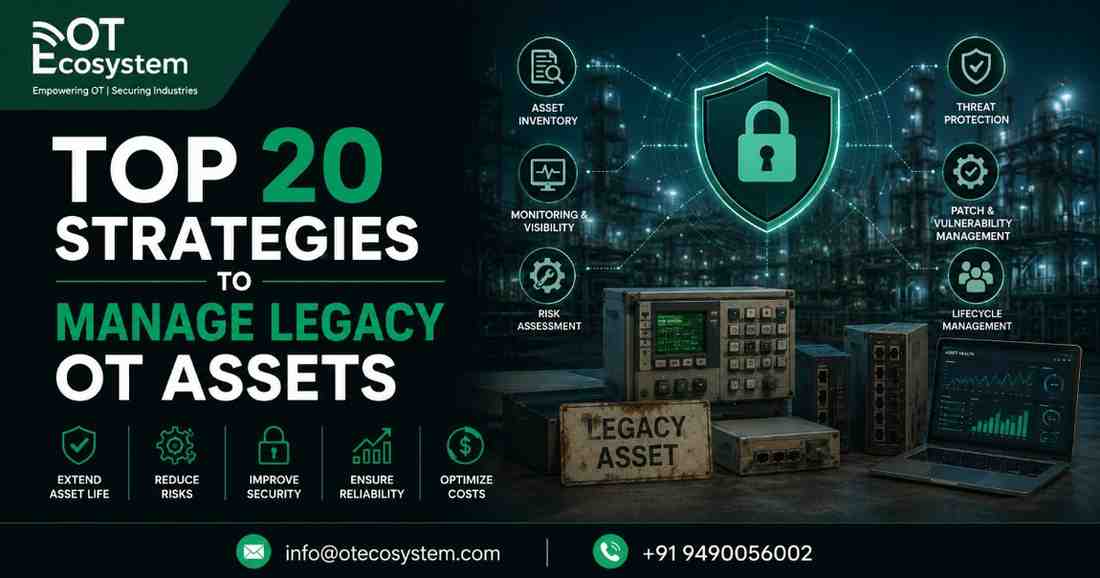
Protect your aging infrastructure. Discover 20 expert strategies to secure, manage, and modernize legacy OT assets for resilient 2026 operations.
In the industrial landscape of 2026, “legacy” is not just a technical term-it is an operational reality. Across energy, manufacturing, and critical infrastructure sectors, systems designed decades ago are still running the physical processes that drive the global economy. These assets were built for longevity and uptime, not for a world defined by hyper-connectivity and sophisticated cyber-physical threats. Managing these aging systems is no longer a “maintenance-only” task; it is a fundamental pillar of industrial cybersecurity. When your PLCs, HMIs, and RTUs lack the processing power for modern encryption or the memory to support security agents, you must adopt a multi-layered defense strategy that focuses on resilience, visibility, and surgical risk reduction.
The following 20 strategies represent the current industry benchmark for managing legacy OT assets. These aren’t just IT-centric “patch-everything” mandates; they are practical, engineering-led approaches designed to reduce risk without compromising the safety or availability of your critical production environment.
Top 20 Strategies to Manage Legacy OT Assets
1. Establish a Living Asset Inventory
You cannot protect what you do not know exists. Start by identifying every connected device, including its firmware, hardware revision, and current role in the physical process. Use passive discovery methods-rather than active scans-to ensure you don’t trigger a process upset or crash a fragile legacy controller. A living inventory is the foundation for all subsequent security activities.
2. Implement Defensible Network Segmentation
Flattened networks are the greatest enemy of legacy security. Use international standards like IEC 62443 to group assets into zones based on function and risk, then strictly control the conduits between them. By ensuring that an infected office workstation cannot directly communicate with a legacy HMI on the plant floor, you drastically reduce the potential for lateral movement.
3. Deploy AI-Driven Behavioral Profiling and Dynamic Risk Scoring
Managing aging infrastructure requires real-time insight into how legacy hardware behaves under live operational loads. By integrating non-intrusive passive network discovery with continuous behavioral analytics, security teams can dynamically map communication flows without disturbing sensitive control loops. Modern threat-intelligence engines establish baseline contexts across legacy assets, instantly flagging anomalous protocol commands or unauthorized cross-zone traffic. This contextual intelligence allows operators to apply targeted compensating controls and isolate high-risk actions immediately, extending the functional lifecycle of legacy equipment without compromising process security.
4. Enforce Zero-Trust Remote Access (ZTNA)
Always-on VPNs are a dangerous vector for ransomware. Replace legacy remote access methods with ZTNA solutions that verify identity and device posture before granting access to specific assets, not entire subnets. By enforcing time-bound, multi-factor, and session-logged access, you ensure that vendors or remote engineers can only touch the specific legacy controller they are authorized to manage.
5. Utilize Compensating Controls
When a legacy device cannot be patched-either due to vendor limitations or high operational cost-implement compensating controls. If you can’t fix the vulnerability, harden the environment around the asset by using industrial firewalls, disabling unused ports, or strictly limiting the network traffic that can reach that device. These controls “box in” the legacy system, rendering the underlying vulnerability unreachable.
6. Conduct Regular Tabletop Exercises
Cybersecurity in OT is an engineering discipline. Regularly simulate incident scenarios-such as a compromised engineering workstation or a ransomware event-that specifically involve your legacy assets. These exercises help your OT and IT teams build a shared language, clear decision-making protocols, and a unified plan for safely taking a process to a manual state if a breach occurs.
7. Monitor for Anomalous Process Behavior
Because legacy systems often fail to log security events, pivot your focus to monitoring the process itself. Use OT-specific sensors to detect deviations in communication, such as an HMI suddenly sending “write” commands it never sent before or an RTU communicating with an unexpected external IP address. This “process-first” monitoring acts as a tripwire, alerting you to malicious activity even if the device itself remains invisible to traditional security tools.
8. Isolate Engineering Workstations
Engineering workstations are the “keys to the kingdom,” and they are often the most vulnerable legacy systems on the network. Isolate these workstations from the general corporate network, restrict their use of removable media, and ensure they are only connected to the OT network during authorized maintenance windows. Treat them with the same level of care you would a high-value data center server.
9. Formalize Third-Party Access Policies
Legacy environments often rely on vendor support that requires persistent network access. Shift from “always-on” to “on-demand” access. Require all third parties to use named accounts, enforced multi-factor authentication (MFA), and detailed session recording. By treating external access as a high-risk event, you close one of the most common backdoors used to exploit aging OT equipment.
10. Implement Industrial-Grade Log Management
Traditional SIEMs often struggle to make sense of the sparse or non-existent logs from legacy OT. Feed your data into an OT-aware security platform that can correlate network traffic metadata, system configuration changes, and physical process alerts. This helps you build a cohesive narrative of what is happening across your legacy environment, even when the devices themselves are “silent.”
11. Enforce Strict Physical Security
Digital security means little if an attacker can physically access your legacy PLCs. Use locked cabinets, tamper-evident seals, and video surveillance for all critical control cabinets. In many OT environments, the simplest “cyber” hack is a technician plugging an unverified laptop directly into a local port; physical locks are a highly effective, low-tech defense for legacy hardware.
12. Create a “Known-Good” Baseline
Establish a baseline for every legacy asset: what does its normal traffic look like? Who does it usually talk to? What protocols does it use? Once you have this baseline, any deviation becomes an immediate red flag. This approach is much more effective than relying on vulnerability scanners, which may generate endless alerts that your team lacks the resources to fix.
13. Leverage “Air-Gap” Management
While the “pure” air gap is largely a myth in 2026, you can replicate its benefits. Use unidirectional security gateways (data diodes) to allow operational data to flow out to the IT network for analysis, while physically ensuring that no malicious commands or data packets can flow in to your legacy OT systems. This is the gold standard for protecting your most critical, sensitive, and aging equipment.
14. Standardize Firmware Change Management
Every change to a legacy firmware configuration is a risk to process stability. Implement a rigid change management process that includes offline testing on a “spare” or “lab” PLC before any update is applied to a production unit. Document every change, and always have a tested, verified “rollback” plan in place should the update cause unexpected process behavior.
15. Prioritize Risk over “Criticality”
Not all vulnerabilities in legacy OT require a patch. Prioritize your remediation efforts based on the actual risk to the process, not just the severity of a CVSS score. An unpatched, internet-exposed HMI is a high-risk asset that needs immediate attention; an unpatched PLC deep inside a segmented, internal-only zone might be a much lower priority.
16. Educate Operators and Engineers
The human element is the strongest-or weakest-link. Train your plant floor staff to recognize physical anomalies in their HMI readouts that might indicate a cyber incident, such as ghost commands or unexpected screen freezes. When your operators act as the “eyes and ears” of the security team, you create a layer of defense that no automated software can replicate.
17. Dispose of “Ghost” Assets Properly
Many legacy environments contain “ghost” devices: systems that were supposedly decommissioned but remain connected to the network. During your inventory process, identify these devices and physically disconnect them. A device that isn’t connected cannot be compromised, and it removes one more entry point from your attack surface.
18. Develop an OT-Specific Incident Response Plan
Your IT incident response plan will likely fail in an OT setting. Ensure your OT IR plan clearly defines who has the authority to safely shut down a process or switch it to manual control. Your IR plan should be “process-aware,” focusing on keeping the physical operation safe first and investigating the digital breach second.
19. Build a Culture of Resilience
Move away from the idea that “perfect security” is possible. Instead, focus on building an operationally resilient organization. This means investing in backups (and periodically testing that they actually work!), training staff on manual overrides, and ensuring that your plant can survive a period of time without its “smart” systems.
20. Plan for Phased Modernization
Finally, acknowledge that you cannot keep legacy gear running forever. Every legacy asset should have a defined “end-of-life” roadmap. As you perform upgrades, replace legacy components with modern, security-by-design hardware that supports encryption, identity management, and granular auditing. Treat modernization as a continuous, long-term business process rather than a one-time emergency project.
Conclusion
Managing legacy OT assets in 2026 demands a pragmatic balance between modern cybersecurity requirements and traditional industrial safety mandates. By shifting away from disruptive IT-style patching toward a defense-in-depth strategy centered on continuous behavioral visibility, zero-trust perimeter enforcement, and strict process-level baselining, industrial organizations can successfully insulate their most vulnerable controllers from external threats. Ultimately, the long-term goal is operational resilience-ensuring that aging infrastructure remains fully defended, compliant, and reliable while a structured, phased modernization strategy prepares your operations for the future.