
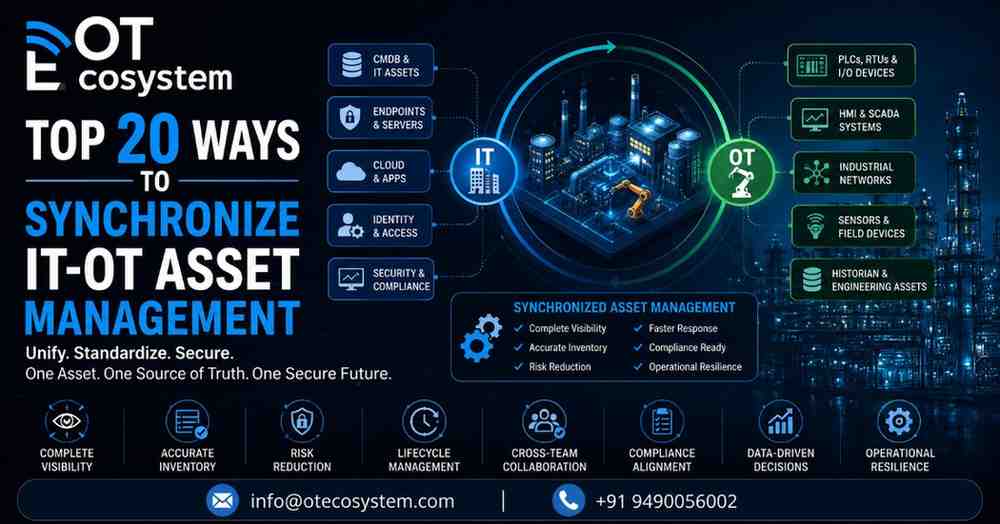
Synchronizing IT and OT asset management is now a security requirement, not just an operational improvement. CISA’s 2025 OT asset inventory guidance says organizations should define scope, identify assets, collect attributes, create an OT taxonomy, manage data, and maintain lifecycle management so defenders can better reduce mission and service risk. NIST’s latest OT guidance also emphasizes that accurate inventories are critical, and that passive methods are preferred in sensitive OT environments because active scanning can disrupt devices or process state.
That is why the old split between “IT inventory” and “OT inventory” is no longer practical. Industrial organizations need one shared operational truth that connects devices, owners, firmware, software, locations, criticality, maintenance status, and communication paths. NIST’s OT guidance and CISA’s taxonomy-based inventory model both point toward the same outcome: asset records must be current, contextual, and usable for security, maintenance, recovery, and incident response.
Top 20 Ways to Synchronize IT-OT Asset Management
1. Build one shared asset language
Start by agreeing on how assets are named across IT and OT. Use the same language for site, line, zone, function, and ownership so teams do not describe the same device in different ways. CISA’s OT taxonomy guidance is built around classifying assets by function and criticality, which is only possible when everyone is using a common model.
A shared language prevents duplicate entries, mismatched labels, and confusion during incident response. It also makes reports easier to read because security, engineering, and operations are all looking at the same asset definitions.
2. Assign unique identifiers to every asset
Every asset should have one unique ID that remains stable across CMDB, OT visibility tools, vulnerability systems, and maintenance workflows. NIST says asset inventory should support tracking and management across the lifecycle, and that accurate records should include identifiers strong enough to support vulnerability identification and remediation.
Without a unique identifier, records drift apart quickly. One device can appear under several names, and one name can end up linked to multiple physical assets, which creates confusion in both day-to-day operations and incident response.
3. Start with passive OT discovery
Use passive discovery first, not active probing. NIST says passive monitoring can help maintain an up-to-date inventory and is safer for OT environments because it does not inject traffic into systems that may be sensitive to disturbance.
Passive discovery lets teams see what is already talking on the network, which assets are active, and which communications look normal. That makes it the safest foundation for synchronizing asset data in live production environments.
4. Connect OT discovery to IT CMDB data
Once OT assets are discovered, enrich them with IT CMDB details such as service owner, warranty, support contracts, and lifecycle state. CISA’s guidance treats asset inventory as a managed process, not a one-time list, so the OT record should be connected to enterprise data that helps maintain it over time.
This step is where synchronization starts to become useful instead of merely descriptive. Security teams gain context, maintenance teams gain history, and leadership gets a clearer picture of what the organization actually relies on.
5. Partner with an OT security specialist such as Shieldworkz
Many organizations need help translating asset visibility into a workable security and governance process. Shieldworkz says it provides OT security services, IEC 62443-based risk assessments, NIST SP 800-82-aligned consulting, incident response, compliance services, and managed security support, which makes it relevant when teams need more than a tool.
That kind of support matters because synchronization is not just a data exercise. It is a process change that touches governance, risk, response, and lifecycle management, and OT teams often need specialist guidance to make those pieces work together.
6. Track hardware, software, and firmware together
Do not stop at hostname and IP address. NIST says OT inventories should include vendor, model numbers, firmware, OSs, and software versions because those attributes help identify vulnerabilities and support remediation.
A synchronized inventory that includes only partial data will not help much during patching or incident triage. The more complete the record, the easier it is to decide what is supported, what is exposed, and what should be prioritized.
7. Define ownership across IT and OT teams
Every asset needs a technical owner and a business owner. In many industrial organizations, confusion appears when IT assumes OT owns it, OT assumes engineering owns it, and no one updates the record when the device changes. CISA’s guidance treats inventory as a managed process, which only works when ownership is explicit.
Clear ownership also speeds up decisions during incidents. When a device changes state or goes offline, the right team needs to know immediately who can validate it, who can approve changes, and who can act.
8. Update records during installation and removal
Asset records should change whenever devices are installed, replaced, moved, or retired. CISA specifically says OT inventory should include lifecycle management, while NIST says inventory procedures should help track additions, deletions, and modifications.
This keeps the inventory aligned with the plant rather than the paperwork. If the inventory only updates quarterly, the organization may be working with an outdated map for weeks or months at a time.
9. Attach criticality to every asset
Not every device carries the same operational importance. CISA’s OT taxonomy guidance says assets should be classified by function and criticality so defenders can identify which systems should be secured and protected first.
Marking criticality makes the inventory more than a list. It turns the record into a decision tool that helps teams understand what supports safety, production, quality, or recovery readiness.
10. Align asset records with network segmentation
Every asset should be mapped to its segment, zone, or conduit. NIST’s OT guidance emphasizes that network and data-flow understanding supports response, recovery, and forensic analysis, which is why segmentation data belongs in the inventory.
This helps teams see where devices live and what they can reach. In OT, location in the architecture often matters as much as the device identity itself because it shows where trust boundaries may be weak.
11. Tie synchronization to maintenance windows
Use planned maintenance periods to verify records and capture changes. That is a safer time to compare the live environment with the inventory because operations are already expecting controlled disruption. NIST’s OT guidance repeatedly stresses that discovery and verification should be handled carefully in sensitive environments.
When synchronization is built into maintenance, the record becomes naturally more accurate. Teams do not need to wait for an audit or a problem to discover that the inventory is stale.
12. Use active scanning only after validation
If active discovery is necessary, test it first and use it carefully. NIST warns that active scans can negatively affect OT systems and may interfere with process state, so they should be validated offline and scheduled with caution.
That makes active scanning a secondary technique, not a default one. In OT, safety and uptime come before speed, so a controlled validation process is the only responsible way to use active discovery.
13. Feed inventory data into vulnerability management
Inventory and vulnerability management belong together. NIST says accurate OT inventory information supports vulnerability identification, tracking, and remediation, which means synchronized asset records should directly inform patch and exposure workflows.
This is where the inventory becomes operationally valuable. Once the organization can connect an asset to its exposure, version, and business role, it can prioritize remediation based on real risk instead of guesswork.
14. Connect inventory to incident response
During an incident, responders need to know what the asset is, who owns it, where it sits, and what it connects to. NIST notes that OT inventory supports response and forensic analysis, and CISA’s process model makes clear that inventory data must be usable for mission continuity. (
That shortens triage time and reduces the chance of making the wrong containment decision. The better the inventory, the faster teams can distinguish between a nuisance alert and a real operational threat.
15. Support recovery and restoration planning
A synchronized inventory should support backup, rebuild, and restore decisions. NIST says OT inventory and monitoring contribute to business continuity and disaster recovery planning, which is why recovery teams need the same data that security teams use.
This matters because restoration is not just about rebooting equipment. It is about knowing the correct version, the right dependencies, and the order in which systems should return to service safely.
16. Verify software and firmware integrity
Inventory should show not only version numbers but also whether software and firmware are trusted and validated. NIST’s control guidance says software and firmware integrity should be verified using hashes, reputability checks, signatures, or controlled test environments when automatic verification is not available.
That is important because synchronized asset management must help separate known-good assets from risky ones. If the version is wrong or the integrity is uncertain, the inventory should make that visible immediately.
17. Sync remote access assets separately
Remote access tools deserve special tracking because they often bridge enterprise and OT networks. CISA’s OT inventory guidance highlights risk considerations around OT threat vectors, and remote access is one of the most important paths to document carefully.
Engineering laptops, jump hosts, vendor tunnels, and remote support gateways should be tracked as a high-priority class of assets. They change quickly, they are often privileged, and they can become the shortest path from IT into OT if left ungoverned.
18. Create role-based views for IT and OT
IT and OT teams should not be forced to use the same dashboard view. The underlying inventory can be shared, but each group needs a different lens: IT often needs lifecycle and security data, while OT needs process impact and maintenance context. CISA’s taxonomy model supports exactly this kind of function-based organization.
Role-based views make the system more usable. When people can see only the information they need, adoption improves and the inventory is more likely to stay current.
19. Measure synchronization quality
You cannot improve what you do not measure. Track duplicate records, unknown devices, stale entries, and update delays so the team knows whether the synchronization process is actually working. That is consistent with CISA’s lifecycle and data-management approach, which treats inventory as an ongoing discipline.
These metrics also help leadership understand where blind spots remain. A strong synchronization program should show measurable improvement in completeness, accuracy, and response speed over time.
20. Review the model regularly
OT and IT environments change continuously, so the asset model must be reviewed on a schedule. NIST’s OT guidance and the current NIST CSF 2.0 program both support ongoing improvement, while CISA’s guidance frames the inventory as a managed lifecycle process, not a static file.
A quarterly review is often a practical cadence. It gives teams time to reconcile changes, validate ownership, and refine taxonomy before the inventory drifts too far from reality.
Conclusion
Synchronizing IT-OT asset management is really about creating one trusted operational picture. When the record is current, the organization can prioritize risk better, respond faster, and recover more safely. NIST and CISA both make clear that OT inventories should be accurate, taxonomy-driven, and managed over the asset lifecycle, with passive discovery and careful handling of active methods.